
The AI buildout meets the local ballot
Our read: the midterms sharpened a divide within the AI buildout—between usable capacity and promises to deliver it. Local restrictions can make an operating site more valuable while making an unfinished one harder to finance. The consequential question is not simply who has the biggest budget. It is who must keep paying when permission, construction and customer acceptance run on different clocks.
A Number That Matters
40 of 41
Ballotpedia reports that voters favored limits on data-center development in 40 of 41 local ballot-measure contests on November 3. The exception was Harwood, North Dakota, where voters rejected an additional industrial-development review requirement.
That is not 40 bans. The tally combines approved restrictions, defeated pro-development proposals and nonbinding advisory votes. These are reported results among communities voting on the question—not certified results independently obtained by UIL, a national opinion poll or a count of canceled projects.
Ballotpedia: local ballot outcomes, November 6

Residents consider a data-center plan; operating racks stand beside a proposed wireframe addition.
AI-generated conceptual illustration, not documentary evidence.
No specific community, project or cancellation is depicted.
Sources: Ballotpedia: local ballot outcomes, November 6 · Anthropic: November 2 amended S-1
This Week’s Thesis
A signed compute contract cannot supply its own electricity. Frontier labs are buying years of future computing; cloud providers and specialist operators must turn those orders into working facilities. Local electorates have a say in whether—and on what terms—some of those facilities get built.
The votes do not establish a national construction stop. They make a more useful distinction urgent: operating capacity is not the same asset as promised capacity. Our read is that tighter local permission can strengthen a legally protected operating site while putting additional pressure on an unfinished project whose bills arrive before its customers can use it.
Follow three clocks: permission to build, delivery of usable capacity, and payment. Where they diverge, a political dispute can become a financing problem. The risk travels through the lab, the cloud provider and the specialist operator; it does not stop at the company name on an enterprise contract.
What Supports the Thesis
The local bargain is changing
A ban, a failed rezoning and an advisory vote do different things. An advisory result expresses a preference. Rejecting rezoning leaves the previous land-use position in place. A binding prohibition or required referendum can create a direct obstacle to development. Treating them all as canceled capacity would mistake political evidence for an operating outcome.
Grove City, Ohio, makes the distinction concrete. WOSU reports that Issue 28 passed with 54.61% support in unofficial results. The city-posted amendment text would require a project vote for developments meeting any of three thresholds: 50 or more contiguous acres, more than 20 MW of peak electrical demand, or more than 500,000 gallons of water a day. Its scope extends beyond data centers.
Under that posted text, qualifying projects would go to a general-election ballot after pre-vote requirements, with at least 90 days between certification of readiness and the vote. Winning the referendum would not guarantee ordinary permits. Applicants would pay for the process, independent impact work and continuing oversight, with financial protections for decommissioning. Registered existing operations would receive limited protection from a retroactive referendum—not unrestricted permission to expand.
This is a proposed allocation of costs as well as a permission process. Residents are asserting a claim on the timetable, oversight and eventual cleanup. Whether the resulting bargain delivers a net community benefit still requires project and utility evidence. The inspected city PDF retains article-number placeholders; its identity with the final certified charter, effective date and enforceability have not been established.
WOSU: Grove City unofficial result Grove City: posted amendment, not certified final text
Existing rights are the next test. Piqua's city statement, quoted by WHIO/The Eagle, says it is unclear how its approved construction restriction affects the Meta project already underway. In Trenton, WCPO reports passage of a restriction on new data centers above 25 MW, alongside disagreement over its application to the existing project. Neither report establishes cancellation. Reported passage, an operative rule, its application to a particular site and lost usable capacity are separate steps.
WHIO/The Eagle: Piqua city statement WCPO: Trenton restriction and existing-project dispute
The labs are buying across election cycles
Anthropic's November 2 amended S-1 reports approximately $895.4 billion of aggregate purchase and lease commitments, substantially all for compute and infrastructure. About $447.5 billion is expected before the end of 2030; substantially all the remainder falls between 2031 and 2045. These are commitments over many years, not money already spent or a construction budget for this year.
For a different measure, the filing records $18.808 billion of compute and infrastructure expense in the first nine months of 2026. That category includes cloud services, equipment and other infrastructure costs; it is not cash capex. The filing also identifies $213.8 billion associated with arrangements subject to exercisable termination rights or conditions before commencement, including financing, facilities or regulatory approvals. That amount is not an estimate of spending threatened by the election.
The terms matter more than another headline total. Some obligations require minimum payments regardless of usage; others depend on delivery and acceptance. Anthropic warns that payments for individual inputs can arise even when failures elsewhere prevent them becoming usable compute. Money can be committed without all the pieces arriving together.
Anthropic: November 2 amended S-1
OpenAI's spending outlook needs a different label. Reuters reported in September, citing a company presentation seen by the Financial Times, a forecast of roughly $856 billion in computing and infrastructure spending through 2030. That is attributed reporting about an internal forecast, not an inspected financial filing or completed investment.
Reuters: reported OpenAI forecast, September 18
OpenAI's own February Amazon announcement documents a specific relationship: its existing $38 billion AWS agreement expanded by $100 billion over eight years, including a commitment to consume approximately 2 GW of Trainium capacity. Contract value and prospective capacity do not establish that the equipment is operating today. Amazon's separate investment in OpenAI finances the customer; it is not another independent compute purchase.
OpenAI: Amazon partnership, February 27
The cloud giants are also customers
Alphabet reported $51.355 billion of cash purchases of property and equipment in Q3. This is consolidated spending, not a Gemini or DeepMind budget and not exclusively data-center buildings. Microsoft reported $45.2 billion of capex in its September-ended quarter, including finance-lease commencement, compared with $39.4 billion of cash property-and-equipment payments. The definitions are different even before comparing the companies.
Hyperscalers have broader businesses through which to earn revenue and absorb or redirect a shock. That does not make their buildouts effortless or equally self-financing. Alphabet's Q3 cash property-and-equipment purchases exceeded its operating cash flow. Microsoft reported positive quarterly free cash flow, but also shifted some third-party capacity deliveries into the second half of its fiscal year.
Alphabet: Q3 release Microsoft: October 28 earnings call
Do not add lab commitments to provider capex to produce an AI investment total. A lab's contract can become a cloud provider's revenue and support its equipment purchases. Those are linked transactions, not independent piles of investment. Expense, cash capex, leases and forecasts also cover different periods and obligations.
Different financial clocks—not comparable spending totals
| Measure | Value and state |
|---|---|
| Anthropic · commitments through 2045 | 895.4 billion (USD) · contracted |
| OpenAI · forecast through 2030 | 856 billion (USD) · forecast |
| Alphabet · Q3 2026 cash PP&E | 51.355 billion (USD) · observed Sources: Alphabet: Q3 release |
| Microsoft · Sep 2026 capex incl. leases | 45.2 billion (USD) · observed Sources: Microsoft: October 28 earnings call |
| Nebius · 364-day facility | 3.5 billion (USD) · contracted Sources: Nebius: October 22 Citi facility |
Independent rows: no common scale, sum or company ranking. A lab’s commitment can become its provider’s revenue and support that provider’s equipment purchases.
Sources: Anthropic: November 2 amended S-1
Specialist operators connect demand to delivery
Neoclouds supply AI-specialized computing and associated software and operating services. CoreWeave, Nebius and IREN illustrate the category, not a single financial model. Their ownership of sites and equipment, customer mix and funding differ. They can compete with hyperscalers and supply them: IREN reports that its Horizon 1 capacity went into service for Microsoft.
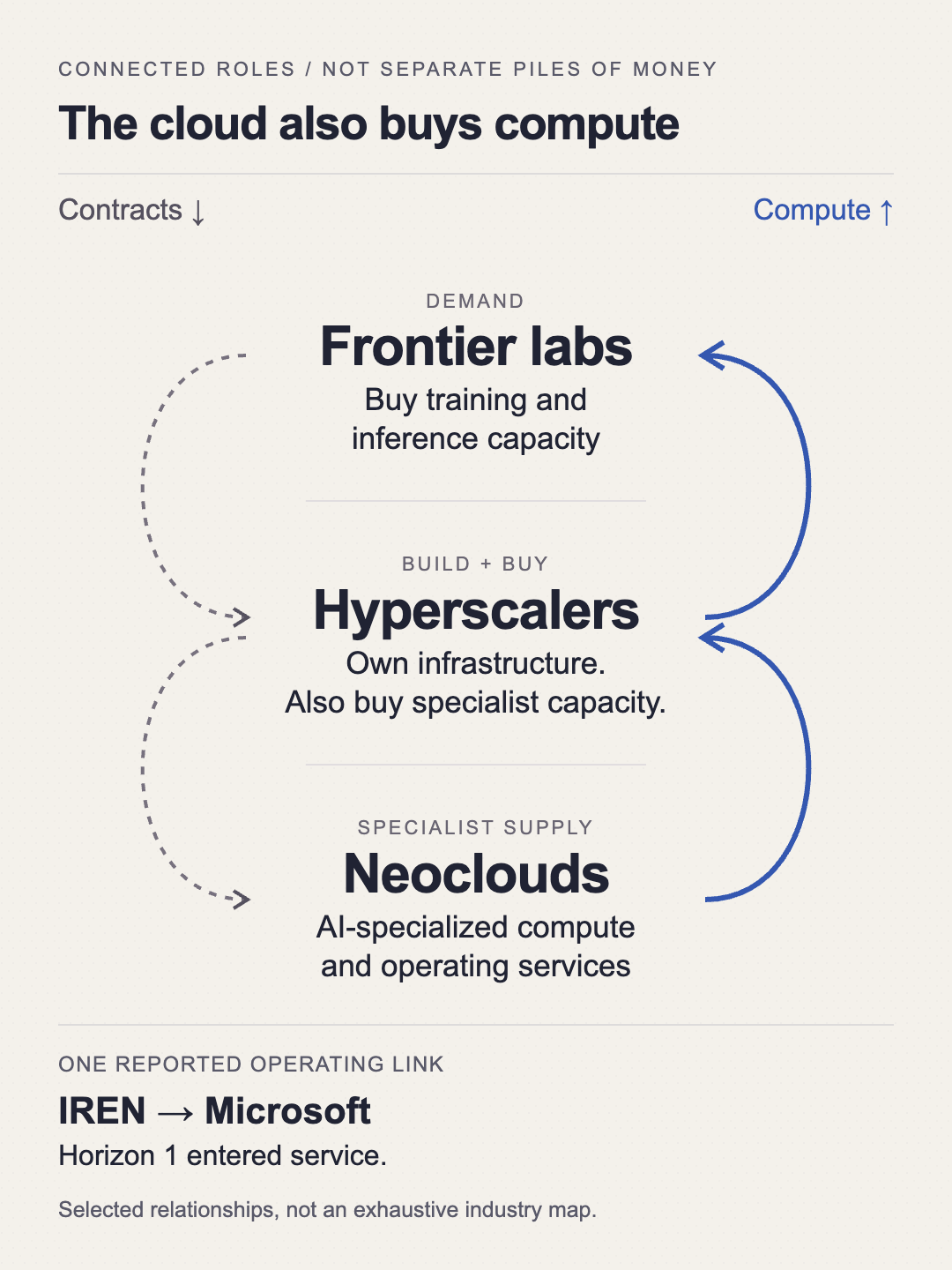
Contracts flow toward providers; compute flows toward customers.
- Contracts and demand
- Labs procure future compute; hyperscalers also purchase specialist capacity. These linked transactions cannot be added as separate investment piles.
- Compute services
- Specialist operators can supply a hyperscaler; IREN reports Horizon 1 capacity in service for Microsoft.
- Overlapping roles
- Hyperscalers build and operate infrastructure as well as purchasing outside capacity. Neoclouds provide AI-specialized compute and operating services.
Authored conceptual relationship illustration, not documentary evidence or a measured flow.
Selected relationships, not an exhaustive industry map. Neocloud ownership, customers and financing differ; this is not three independent investment totals.
Sources: OpenAI: Amazon partnership, February 27 · IREN: November 5 results
IREN's November 5 results show both delivery and its limits. It reported $200 million of quarterly AI Cloud revenue and $20.3 billion of future revenue backlog. Its more-than-$4-billion annualized-run-rate revenue target moved from year-end to January, potentially February 2027, because of a customer-requested design change and supplier timing. ARR is an annualized operating metric, not recognized quarterly revenue. This delay is not evidence of an election-caused setback.
Funding is similarly specific. IREN identifies $15 billion of remaining planned FY2027 capex: $9 billion of cash and committed financing/prepayments, plus $6 billion of target funding subject to market conditions. Its narrower ARR program is described as funded; that is not unconditional funding for all expansion. A post-quarter customer contract provides prepayments covering 90% of associated estimated GPU capex—a substantial counterweight to the idea that specialists must bear every hardware cost themselves. Contractually payable prepayments need not all be cash already received.
Nebius illustrates a different clock. Its October 22 announcement describes a $3.5 billion senior secured Citi facility with a 364-day maturity, alongside more than $40 billion of long-term investment-grade customer commitments. A short bridge can be an efficient choice. A long customer contract does not, however, extend the bridge's maturity if delivery or replacement financing takes longer.
Nebius: October 22 Citi facility
CoreWeave's Q2 release reported $104 billion of backlog as of June 30, subject to delivery and service availability, alongside $640 million of quarterly net interest expense. These are dated quarterly observations, not November totals. CNBC reported on November 6 that the market yield on its 2032 bond had risen above 16%. That is a warning about credit conditions, not proof of default, a change to its existing coupon or evidence that the election caused the move.
CoreWeave: Q2 results CNBC: November 6 bond-yield reporting
Where the pressure can land
Our read is differentiation, not a uniform spending collapse. The useful questions concern asset stage and contract terms, not whether a company carries the label hyperscaler or neocloud.
- Operating, legally protected capacity could gain bargaining power if nearby alternatives become harder to build. A speculative pipeline does not receive the same protection merely because its owner already operates elsewhere.
- Contracted but unfinished capacity can face the opposite pressure: customer payments may wait for acceptance while equipment, construction and financing obligations continue. Additional uncertainty can matter before a project is definitively prohibited.
- Communities can change the bargain as well as the location. Oversight and cleanup requirements seek to put costs back with developers. A successful relocation could preserve national capacity while moving jobs, tax receipts and environmental burdens to different residents.
What Challenges the Thesis
The strongest counter-read is that the industry can work around local restrictions faster than they reduce usable supply. Some votes are advisory; existing approvals may survive. Developers can choose other jurisdictions, customers can finance scarce hardware, and efficiency can increase useful work from installed equipment. Microsoft reports throughput gains and deployment despite third-party delays. IREN's customer-funded GPU contract shows a practical way to share the cost of expansion.
If alternative sites deliver on time and efficiency absorbs the constraint, these elections may redistribute development more than reduce aggregate capacity. That would weaken a claim of broad industry scarcity, even while leaving individual projects exposed. Conversely, weak utilization or disappointing AI economics could cut spending without any help from local politics.
We still land on contract structure and asset stage as the better guide. The evidence already distinguishes operating services, conditional backlog and funding that must be renewed. It does not yet tell us how many usable megawatts the votes remove, which lab contracts touch affected projects or how much financing and price movement is attributable to the election. A company-by-company winner ranking would outrun it.
What to Do With This
For an enterprise buyer, infrastructure due diligence needs to reach beyond the model and the cloud logo. Ask the provider to distinguish the operating capacity supporting your service from future capacity on which its expansion depends.
- Ask what happens if the future site is late: where replacement capacity would come from, whether your service commitments change, and which payments depend on acceptance. An announcement, a backlog number and an energized facility answer different questions.
- For leaders evaluating the buildout, watch certified rules and existing-project rights first; delivered and accepted capacity second; financing maturities and committed funding third. The sequence helps distinguish a contested proposal from an actual service or balance-sheet constraint.
- For communities, the corresponding question is what the agreement leaves locally: funded oversight, enforceable operating limits and cleanup security, alongside evidenced jobs, tax receipts and infrastructure costs. A large investment announcement is not itself the local benefit calculation.
How Sure Are We?
High confidence in what the retained financial disclosures say and in Ballotpedia's attributed voting pattern; not independent certification of each result or validation of company forecasts. Moderate confidence in our interpretation that permission and schedule risk can separate operating assets from promised capacity. Low confidence in any current national capacity-loss total, provider ranking or precise election-driven compute-price forecast.
What would strengthen the read: operative restrictions tied to named projects, documented slippage in customer acceptance, and financing disclosures showing costs continuing while service revenue waits. Those links would connect the political mechanism to an actual financial consequence.
What would weaken it: affected projects retaining their rights or moving to powered replacement sites without material delivery slippage, alongside demonstrated efficiency gains that absorb the constraint. Stable acceptance dates and funding terms across exposed projects would be stronger contrary evidence than another large spending announcement.
One Question to Take With You
When an AI company buys years of computing in advance, who pays for the time before that computing is permitted, built and usable?